Friday, 2 May 2014

7. As Many Faiths, So Many Paths

Within a few years of its consecration, the Dakshineswar Temple attracted many devotees and holy personalities. This is mainly due to the generosity of Rani Rasmani and Mathur Babu who spent a large amount in feeding the holy men and devotees. Many pilgrims to the Holy City of Puri, often halted at Dakshineswar. Some of them, came into close contact with Sri Ramakrisna.  


After completing the Tantrik disciplines, Sri Ramakrisna took up several other paths leading to God. Around 1864, a great Vaishnava called Jatadhari came to Dakshineswar. He was a wandering monk. He worshipped Ramlala (Child Rama) in a wooden image. After years of meditation, prayer and worship, he had reached an exalted spiritual state. He could actually see and feel the presence of Ramlala all the time.   


Sri Ramakrishna also saw that Ramlala was living with Jatadhari. Naturally, he too started playing with Ramlala. Day by day, Ramlala became more attached to Sri Ramakrishna. Like a naughty child, He teased Sri Ramakrishna. Sometimes, he refused to take food, unless Sri Ramakrishna feed him. One day, Jatadhari came to Sri Ramakrishna and bid farewell. He left Ramlala in Sri Ramakrishna’s care saying that Ramlala was happy to be with Ramakrishna and He had refused to leave Dakshineswar. 

Soon after this, Totapuri, a naked monk came to Dakshineswar. He was a follower of Advaita. After forty years practice, he had reached the state of a Paramahamsa and attained Nirvikalpa Samadhi (Non-dual state). Finding Sri Ramakrishna a fit person to learn the Advaita philosophy, he approached him. Upon obtaining the permission of the Divine Mother, Ramakrishna agreed to be a disciple of Totapuri. On an auspicious day, Ramakrishna, shaved his head and took the monastic vow. Then, he was initiated into the Advaita mantra. After giving the instruction for meditation on the Formless Brahman, Totapuri locked him in a small hut. On the third day, he opened the door of the hut. Sri Ramakrishna was in Nirvikalpa Samadhi. Totapuri was amazed that his disciple could reach that state within three days, whereas he himself had to struggle for it for forty years. 

Totapuri had never stayed in any place for more than three days. However, the attraction he felt for Ramakrishna, kept him in Dakshineswar for more than eleven months. Every day, he talked to Ramakrishna about Advaita Philosophy. Ramakrishna soon realised that Totapuri was bigoted and his knowledge was one-sided. He did not believe in the forms of God and often ridiculed Ramakrishna for worshiping the image of Bhavatarini. However, through the companionship of Sri Ramakrishna, finally, Totapuri accepted the Divine Mother, as the Shakti aspect of Divinity.


Towards the end 1866, Ramakrishna met Govinda Rai, a Sufi mystic. Soon, the idea came to Ramakrishna to experience Truth following the Islamic faith. He, then, got the Islamic initiation from Govinda Rai and learned the methods of worship and prayer in the Islamic way. During this time, Ramakrishna dressed like the Muslim, ate their food, and prayed to Allah regularly. He also stopped going to the Hindu temple. On the third day, he saw a radiant Being, with long beard and grave appearance. It was the Prophet Mohammed.

On another occasion, Ramakrishna was sitting in the parlour of Jadu Mallick. He was looking at the photos on the wall and his eyes fell on Madonna with the Child. The more he gazed at the picture, the more he felt attracted towards it. Suddenly, a ray of light came from the picture and entered him. Images of Christian performing worship came before his eyes. This experience continued for three days. During this time, he forgot everything about the Hindu God and Goddesses. On the fourth day, as he was sitting under the Panchavati, he saw a tall luminous figure approaching him. It soon dawned on him, that it was Jesus Christ. The serene figure, then, entered and merged in Ramakrishna. This experience convinced him that Jesus Christ too, was an Incarnation of God.


8. Days with Mathurnath

Mathur Babu became the sole administrator of the temple garden of Dakshineswar after the demise of Rani Rasmani. With the intention of ensuring a comfortable life for Ramakrishna, Mathur wanted to give him some property. Hearing this proposal, Ramakrishna immediately rebuked him and said, “Do you want to make me a worldly man?” Hearing these words, Mathur did not pursue the matter anymore.


One day, in the course of a conversation, Mathur argued with Sri Ramakrishna. “Even God must obey by His law,” Mathur said. “Once God makes a rule, He Himself cannot change it.” Sri Ramakrishna did not agree to this. “A person who makes a law, also has the power the alter the law,” Ramakrishna explained. Mathur did not agree and he illustrated that if God decided that a certain tree shall bear white flowers, then the tree would bear only white flower and not red. Ramakrishna did not argue further. The next day, he was walking in the temple garden. He saw a tree which had a red and white flower on the same branch. With delight, Ramakrishna broke the branch and went to Mathur. “Look, what God has done!” Mathur was speechless. He agreed that God can do whatever He wants. 

Once a thief stole the jewels from the images in the temple of Radhakanta.  Mathur Babu entered the temple and said to the Deity: “What a shame, O God! You couldn't save Your own ornaments.” Hearing this, Ramakrishna said to Mathur.  “Does He who has Lakshmi for His handmaid, and attendant, ever lack any splendour? Those jewels may be precious to you, but to God, they are no better than lumps of clay.  Shame on you! What riches can you give to God to magnify His glory?”

Pilgrimage
In 1868, Mathur took Sri Ramakrishna on a pilgrimage to Varanasi and Vrindavan. It was a huge group of over 150 people. They started on a train from Kolkata. 

On the way, they halted at Deogarh to visit the Vaidyanath temple. The place was wrecked by severe famine. Everywhere, people looked like skeletons. Ramakrishna could not bear the sight of suffering. With tears in his eyes, he asked Mathur to feed the people and give them a piece of cloth each. Mathur, a very practical man, was reluctant, as huge sum of money will be required for the pilgrimage. 


Varanasi - 1880's
This angered Ramakrishna. He refused to leave the place and said that he would rather stay with the villagers. Mathur had no choice but to please Sri Ramakrishna. He arranged for food and gave all the people a piece of cloth and oil for bath. After distributing the alms, they then left for Varanasi. 

Varanasi appeared a veritable City of Gold to Sri Ramakrishna. Accumulated spiritual moods, over the ages, had solidified and seemed to fill the whole atmosphere of Varanasi. Every day, Ramakrishna went to pray at the temple of Vishwanath. He also met many notable monks and holy men of the place.

Ramakrishna was very much impressed with Trailanga Swami. The Swami was then observing a vow of silence. However, using gestures, he communicated with Ramakrishna. Ramakrishna also entertained him with a feast.

During this pilgrimage, one day, Sri Ramakrishna was seated in the drawing-room of their host with Mathur, and some others. The gentlemen started talking about various worldly matters, such as their business losses. Sri Ramakrishna’s mind at this time, did not enjoy any conversation, but that about God. Unable to bear the pain of hearing such talks, made him weep bitterly to the Divine Mother. He cried: “Mother, where have You brought me? I was much better off in the temple garden at Dakshineswar. Here I am in a place where I must hear about 'woman and gold'.  But at Dakshineswar I could avoid it."

Then, the party visited Allahabad and bathed in the confluence of Ganga and Jamuna. Next, they visited Vrindavan. Ramakrishna enjoyed his stay in Vrindavan like a child. During dusk, he walked on the bank of the Jamuna. Seeing the cattle returning along the sandy banks from their pastures, the thought of Krishna would flash in his mind. He would run along like a madman, crying: "Oh, where is Krishna? Where is my Krishna?"

At the sight of Mount Govardhan, he was overwhelmed with divine emotion and he ran to the top. He lost all consciousness of the world. Helped by the residents of the place, he came down from the mount. While going to Syamakunda and Radhakunda, when he saw the meadows, the trees, the shrubs, the birds, and the deer, he was in an ecstatic mood. His clothes became wet with tears.  He cried: "O Krishna! Everything here is as it was in the olden days. Only You are absent." Thus, choked with emotion, he could not speak anymore.

One day, while walking in the streets of Vrindavan, he saw two youths of exceeding beauty. Approaching Ramakrishna, they merged in his body. They were Sri Krishna Chaitanya and Prabu Nityananda. 

After completing the pilgrimage, the party returned to Kolkata. In July 1871, Mathur Babu passed away of typhoid fever. He had served Sri Ramakrishna for fourteen years. With his demise, a new chapter in the life of Sri Ramakrishna started. 


9. Arrival of Sarada Devi

After his marriage with Sri Sarada Devi, Ramakrishna had left her in her parents’ home at Jayrambati. Now, Sarada, a young woman of eighteen, turned up at Dakshineswar to stay with her husband. It was March, 1872.

The reason for her sudden arrival was the rumours that reached her that her husband had become stark mad. Intent upon finding the truth and also to serve her husband during his illness, she started on foot to Dakshineswar. It was a 90km journey. Finally, when Sarada reached Dakshineswar, she was ill with fever. 

Ramakrishna, received her cordially, and arranged for her treatment. He accommodated her at the Nahabat, where his mother, Chandra Devi had been spending her last days. The Nahabat was a tiny room. Sarada turned it into her kitchen, dining room, living hall and bedroom. There was no furniture or anything of comfort. Sarada lived here in extreme simplicity, leading a pure life like a nun. Finding that Ramakrishna was in good health, Sarada felt relieved. She then took up the duty of serving Ramakrishna and his aged mother. 

Ramakrishna, though had taken the monastic vow, did not show any indifference to his wife. He treated her with respect and love. He also started instructing her on various matters, namely spiritual, religious and worldly. Under his guidance, Sarada progressed in her spiritual life. Ramakrishna taught her, “God is everyone’s Beloved. Everyone has the right to pray to Him. Out of His grace, He reveals Himself to those who seek Him. You too can see Him, if you pray sincerely.”   


During her early days at Dakshineswar, Sarada prayed fervently that her mind may be pure and free from any blemishes. One day, Ramakrishna asked her, “Have you come to drag me to worldly life?” Without hesitation, Sarada replied sharply, “Why should I do that? I have come to help you in your spiritual life.” Ramakrishna felt greatly relieved with this reply. 

On another day, it was Sarada’s turn to test her husband. She asked while stroking his feet, “What do you think of me?” Ramakrishna answered her, “The One in the temple, the one who gave birth to this body and the one stroking this feet now, are one and the same Divine Mother.”  

A few months later, one day, Ramakrishna called Sarada to his room. All arrangements for the Shodasi worship had been done. He asked her to sit on the seat reserved for the Goddess. Then, Ramakrishna worshiped Sri Sarada Devi as the Divine Mother. All these years, he had worshiped the Divine Mother only in image. Now, he worshiped Her in his own wife. After completing the ritual worship, he surrendered to her all the fruits of his spiritual practices and saluted her. This event reminded Sarada of her own Divinity and awakened the Universal Motherhood in her. Thus, Sarada Devi became the Holy Mother. 

Soon, many people came to Dakshineswar to meet Sri Ramakrishna. Sarada Devi spent her time, preparing their meals and serving them. She looked upon all as her own children and everyone felt that she was their own mother.


Thursday, 1 May 2014

10. Coming of Disciples

By now, Ramakrishna had completed all the various spiritual disciplines and achieved the goal of different religions. He had realisation that God can be attained through all religions. The most important criteria to reach God are sincere yearning of the heart. God is the one remedy for all the sufferings in the world. Sri Ramakrishna, out of his infinite mercy, felt that he must distribute his knowledge and realisation to all people. Now onwards, for the rest of his life, he spent for this sole purpose.

Just as during his early days of spiritual practice, he yearned for God, now he yearned for sincere seekers of God. He felt pained to be in the company of worldly people. He cannot talk to them about God or his spiritual experiences. He knew, as the Divine Mother showed to him, that many would come to him to seek spiritual solace. When the evening bells for prayer rang, he climbed the roof a building in the garden, and cried at the top of his voice, “Come, my boys! Where are you? Come, I cannot live without seeing you.” This continued for some time. Then, finally, his disciples and devotees, arrived at Dakshineswar.

The first to come to him, was the cousins, Ramachandra Datta and Manomohan Mitra. It was the year 1879. Ramachandra Datta had read about Sri Ramakrishna in a newspaper article. So, with his cousin, he came to Dakshineswar. At the very first meeting, they were charmed by the kindness, cordiality and sympathy shown by Ramakrishna. They felt that he was their own. Their visit to him increased. Soon, they also brought their family and friends to meet Sri Ramakrishna.

Ramachandra Dutta introduced his friend Surendra Nath Mitra to Sri Ramakrishna. Surendra, an aristocratic man was leading a carefree life, in drinking and frequenting brothels. However, Sri Ramakrishna, who understood the different temperament of people, did not condemn him. He assured that once the taste for enjoyment has been wiped from the mind, Surendra would seek God. The kindness of Sri Ramakrishna, slowly turned Surendra’s mind to God. By nature, he was a benevolent man. Whenever required, he spent lavishly for Ramakrishna and supplied his personal needs. Ramakrishna informed that Surendra was one of his suppliers sent by the Divine Mother.  

Balaram Bose 
In 1882, Balaram Bose came into the fold of Ramakrishna. Though he hailed from a rich aristocratic family, he surrendered to Sri Ramakrishna with humility. His house in Kolkata became a parlour to Sri Ramakrishna. He often spent his time there with the Kolkata devotees. Balaram also was another supplier sent by the Divine Mother.

Keshab Chandra Sen 
Keshab was the leader of the Brahmo Samaj, a movement which championed the reformation movement in Hinduism. The young generation of Bengal looked upon Keshab as their idol and his fame had spread even to England. Coming into contact with Sri Ramakrishna, Keshab started to appreciate the Hindu religious truth, especially the worship of the Divine Mother. He started to write about Sri Ramakrishna and to speak about him in public congregations. Through Keshab, many young, educated men came to Sri Ramakrishna.

Mahendranath Gupta 
In February 1882, Mahendranath Gupta, a school teacher came to visit the temple garden of Dakshineswar. Though it was a casual visit, Mahendranath was attracted towards Sri Ramakrishna. The very next day, he returned to Dakshineswar and completely surrendered to Sri Ramakrishna and became a disciple. For four years, Mahendranath visited Sri Ramakrishna and recorded everything in his diary. Many years later, after Sri Ramakrishna’s passing away, Mahendranath, with the pen name ‘M’ published his diary as Kathamrita in Bengali. Subsequently, this book was translated into English as "The Gospel of Sri Ramakrishna". 
Girish Chandra Ghose 
Another interesting character in the life of Sri Ramakrishna was Girish Chandra Ghosh. He was a famous dramatist of that time. Girish had imbibed all the bad habits that a city like Kolkata can offer. In fact, he was even bold enough to come before Sri Ramakrishna in drunkenness and address him in abusive language. Some of the devotees and disciples were astonished and displeased with the shameless behaviour of Girish. However, Sri Ramakrishna showed him love and care because Girish had sincerity. Though he lacked any quality to lead a spiritual life, Girish had tremendous faith in Sri Ramakrishna. 

One day, Girish came to Sri Ramakrishna and expressed his weakness and inability to practice any spiritual discipline due to his carefree lifestyle. Sri Ramakrishna tried to persuade him to do simple things, like remembering God’s name at least at the time of eating. Girish could not even promise that. Finally, Sri Ramakrishna said, “Then, give me your power of attorney. I  shall  take your responsibility.” Girish happily agreed to this. However, soon, Girish realized that after giving away his power of attorney to Sri Ramakrishna, he had lost all power to take any decision about himself. At every step, he had to think of Sri Ramakrishna and surrender to God’s will. After a few years, it became apparent to everyone that Sri Ramakrishna had transformed Girish into a great devotee. 

Future Monks 
Along with married people, some sincere unmarried youths also gathered around Sri Ramakrishna. Though at this time, Ramakrishna was in his fifties, he attracted the youths by his purity, love, simplicity and catholicity of views. Often, he would joke and laugh with the boys. His sweet singing of devotional songs also captured the hearts of all. He made all feel that God is a living presence which anyone can experience. Ramakrishna instilled into their hearts that God can be attained by those who forsook everything for His sake. He saw in them the bearers of his message to posterity. He trained each one of them according to their inherent tendencies and capacities. 

Sri Ramakrishna, once saw in a vision a boy dancing with Sri Krishna in Vrindavan. One day, he saw the same boy coming in a boat to Dakshineswar. His name was Rakhal. Since the first meeting, Rakhal looked upon Sri Ramakrishna as his mother. Sri Ramakrishna and Sri Sarada Devi treated Rakhal as their spiritual son. Rakhal soon left his family and started to live with Sri Ramakrishna. Later, he became Swami Brahmananda, the first president of Ramakrishna Mission.

Latu, was a servant boy in the house Ramachandra Datta. Sometimes, Ramachandra would take Latu to Dakshineswar. At home, Ramachandra also would speak about Sri Ramakrishna to his friends and family. This was sufficient to stir the innate spiritual tendency in Latu. He longed to be with Sri Ramakrishna and serve him. Once, Sri Ramakrishna had gone to Kamarpukur for some months. Latu could not bear the pain of separation. Often, he would be crying. When questioned, he would not speak his mind. Somehow, understanding the boy’s feelings, Ramachandra gave him a photograph of Sri Ramakrishna. When Sri Ramakrishna returned to Dakshineswar, he requested Ramachandra to send Latu to Dakshineswar. Unable to believe his luck, Latu came to live in Dakshineswar and serve his guru, Sri Ramakrishna. Later, Latu became Swami Adbhutananda.


Nitya Niranjan Ghosh, was another disciple of Sri Ramakrishna who later became a monk. During his boyhood, he had clairvoyant powers and he was used as a medium by spiritualists. Reproving this, Sri Ramakrishna said to Niranjan: “My boy, if your mind constantly dwells on ghosts, you’ll become a ghost yourself. If you fix your mind on God, your life will be filled with God. Now – which are you going to choose?”   

In November 1881, Surendra invited Sri Ramakrishna to his house and arranged a musical performance. Narendranath Datta, an accomplished singer and musician, sang on that day. He was then, a college student. Soon, Narendra came to Dakshineswar and asked Sri Ramakrishna: “Sir, have you seen God?” Sri Ramakrishna, who had already recognised Narendra as his own, replied, “Yes, I have seen God. I am seeing God more clearly than I see you now. Moreover, if you want, you too can see God.” This sincere, bold reply captivated Narendra. He became Swami Vivekananda, the foremost disciple of Sri Ramakrishna. 


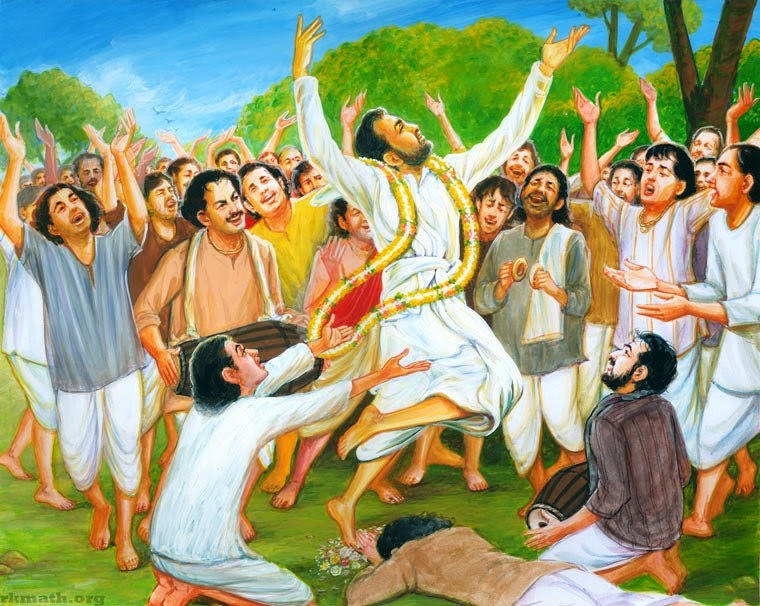
When more disciples and devotees gathered, naturally, it will create a joyful atmosphere. Soon, the room where Sri Ramakrishna stayed became a mart of joy. Day and night, devotional songs were sung to the accompaniment of musical instruments. Ramakrishna spoke to them about God and filled their minds with peace and joy. During the nights, Sri Ramakrishna taught his disciples to meditate on God, and he himself would be in deep communion with God. At times, Ramakrishna visited the houses of the devotees and also other places with them performing Sankirtan and discoursing about God. 

Other youngsters who came to Sri Ramakrishna were Baburam, Shashi, Sharat, Tarak, Subodh, Yogin, Sarada, Hari Prasanna, Hari and Kali. After Sri Ramakrishna attained Mahasamadhi, they renounced the world and became monks.

Tuesday, 29 April 2014

11. The Last Days

During the summer of 1885, Sri Ramakrishna suffered terribly because of the heat. Some devotees started bringing ice to prepare cold drinks for him. One of the young disciples, Shashi used to carry ice cubes, carefully wrapped in papers, walking all the distance from his home to Dakshineswar.

Several weeks later, Ramakrishna started to feel pain in the throat. Though, medication was prescribed, it proved futile. Soon, it was diagnosed that he was suffering from throat cancer. Though it was incurable, for better medical treatment, the doctors suggested him to move to Kolkata. Therefore, Sri Ramakrishna moved to Syampukur first, and then later to a suburb called Kasipur.

On December 11, 1885, Sri Ramakrishna shifted to the garden house of Kasipur. Here, he stayed for eight months until his Mahasamadhi. It was a two-storeyed house surrounded by flower garden and orchards. The air was cool and clean. In its secluded atmosphere, Sri Ramakrishna spent his last days with his intimate disciples.
Sarada Devi assisted by some women devotees, took charge of cooking the meals for Sri Ramakrishna and his attendants. Some of the young unmarried disciples, Narendra, Rakhal, Shashi, Baburam, Latu, Tarak, Niranjan, Yogin, Sarat, the elder Gopal, Kali and the younger Gopal came to stay with him and take care of him. The householder disciples took charge of the rental and other expenses. The doctor, who came to treat him, offered his service free of charge.

In the Kasipur garden house, Sri Ramakrishna trained his beloved disciple Narendra. He knew Narendra was the man to lead all the other disciples to carry out his message to the world. Day after day, he called Narendra to his room and instructed him. One day, he scribbled on a piece of paper: “Narendra will teach.” Narendra’s protest was futile as Ramakrishna emphasised, “Even your very bones will do it.” 


As days go on, Sri Ramakrishna could hardly speak and used gestures to communicate. At times, the pain in the throat increased and he vomited blood. Yet, despite all this, Ramakrishna did not stop giving instruction and solace to those who came to him.

One day, a scholar suggested that a yogi could cure his own illness by concentrating his mind on the affected part of the body. Therefore, Ramakrishna also could do the same. Hearing these words, Ramakrishna rebuked the scholar and added, “I have given my mind to the Divine Mother.  How can I bring down my mind to this worthless cage of flesh?” 

After the scholar left the place, the disciples tried to cajole Ramakrishna to cure his illness, at least for their sake. Finally, he agreed to pray to the Divine Mother to alleviate his pain. Then, a few hours later, he said to Narendra: “I told the Mother that because of the pain, I could not eat anything. I asked Her to make it possible for me to eat a little. The Mother pointed to all of you and said, ‘Are you not eating through all these mouths?’ I felt ashamed and kept silent.” Hearing these words, the disciples understood that there was no more hope that Ramakrishna would recover.  


It was January 1, 1886. Many of the devotees had come from Kolkata. Around afternoon, Ramakrishna came down to stroll in the garden and stood under a mango tree. Seeing Girish, he said, “Well, I heard that you are proclaiming to everyone that I am an incarnation of God. What made you say so?” Girish knelt down, and with folded hands said, “What can a worthless person like me say about the One whose glory, even sages like Vyasa and Valmiki could not measure?” Touched by this sincere word, Sri Ramakrishna said, “What more shall I say? I bless all of you. Be illumined.” These words acted like a spell. The whole place was filled with bliss and joy. All the devotees present, rushed to Sri Ramakrishna and touched his feet. Without any restriction he blessed them all and granted them spiritual experiences, according to everyone’s temperament.  

One day, Sri Ramakrishna called all his young disciples and distributed a piece of ochre cloth of the monk and a Rudraksha garland to every one. Then, he ordered them to go for begging in the fashion of traditional monks. When the young monks came with their bhiksha, Ramakrishna joyfully partook the offering.  


During the last few days of his life, Sri Ramakrishna called Narendra to his side. Looking intently at Narendra, he then went into Samadhi. Narendra felt a subtle force entering his body and he lost consciousness. When he regained his normal state of mind, he found Ramakrishna was weeping. With choked voice, Ramakrishna said: “Naren, today I have given you my all. Today I have become a fakir. With the powers that you just received, you shall do great works for the good of the world.” 


A few days later, Ramakrishna and Narendra were alone in the room. Looking at Ramakrishna’s face, Narendra thought: “If now, at the verge of death, he admits that he is an Incarnation, then, I shall believe him.” Ramakrishna, smiled and said, “Even now, do you doubt? He who was Rama, and He who was Krishna, is now in this body as Ramakrishna, but not in your Vedantic sense.”  Embarrassed for doubting Sri Ramakrishna, Naren hung his head. 

At midnight on Sunday, August 18, 1886, Sri Ramakrishna attained Mahasamadhi. His body was consigned to the flames at the bank of the Ganges. Some of the disciples, in the company of Holy Mother Sri Sarada Devi set out on pilgrimage. 

Two months later, the young disciples led by Narendra, started their monastery at Baranagore. Here, they worshiped the Holy Ashes of Sri Ramakrishna. Day and night, they practiced intense spiritual practices, like meditation, Japa, singing devotional songs, and studying the various religious scriptures. After many years of struggle, Narendra built a temple at the Belur Math, where the Holy Ashes were enshrined permanently. Belur Math, since then became the center for the propagation of Sri Ramakrishna’s ideals. 

 Sri Ramakrishna's Image Worshipped in Belur Math


* * *

For more information on Sri Ramakrishna, please visit the official website of Ramakrishna Math & Ramakrishna Mission - www.belurmath.org

12. The Gospel of Sri Ramakrishna

Mahendranath Gupta, or popularly known as  M. had taken down the conversations of Sri Ramakrishna (the Master) and later published it as Kathamrita in Bengali. This book was translated into English  by Swami Nikhilananda as ‘The Gospel of Sri Ramakrishna’.

Some extracts from the book are given here.
 
God and worldly duties
M. (humbly):"How ought we to live in the world?"

MASTER: "Do all your duties, but keep your mind on God.  Live with all - with wife and children, father and mother - and serve them.  Treat them as if they were very dear to you, but know in your heart of hearts that they do not belong to you. 

"A maidservant in the house of a rich man performs all the household duties, but her thoughts are fixed on her own home in her native village.  She brings up her Master's children as if they were her own.  She even speaks of them as 'my Rāma' or 'my Hari'.  But in her own mind she knows very well that they do not belong to her at all.
 
"The tortoise moves about in the water.  But can you guess where her thoughts are? There on the bank, where her eggs are lying.  Do all your duties in the world, but keep your mind on God. 

"If you enter the world without first cultivating love for God, you will be entangled more and more.  You will be overwhelmed with its danger, its grief, and its sorrows.  And the more you think of worldly things, the more you will be attached to them. 

Respect for other faiths
(To Kedār and the other devotees) "God can be realized through all paths.  All religions are true.  The important thing is to reach the roof.  You can reach it by stone stairs or by wooden stairs or by bamboo steps or by a rope.  You can also climb up by a bamboo pole. 
 
Many names of one God
"You may say that there are many errors and superstitions in another religion.  I should reply: Suppose there are.  Every religion has errors.  Everyone thinks that his watch alone gives the correct time.  It is enough to have yearning for God.  It is enough to love Him and feel attracted to Him: Don't you know that God is the Inner Guide? He sees the longing of our heart and the yearning of our soul.  Suppose a man has several sons.  The older boys address him distinctly as 'Baba' or 'Papa', but the babies can at best call him 'Ba' or 'Pa'.  Now, will the father be angry with those who address him in this indistinct way? The father knows that they too are calling him, only they cannot pronounce his name well.  All children are the same to the father.  Likewise, the devotees call on God alone, though by different names.  They call on one Person only.  God is one, but His names are many."

Futility of mere lecturing
"What can you achieve by mere lecturing and scholarship without discrimination and dispassion? God alone is real, and all else is unreal.  God alone is substance, and all else is nonentity.  That is discrimination. 

"First of all set up God in the shrine of your heart, and then deliver lectures as much as you like.  How will the mere repetition of 'Brahma' profit you if you are not imbued with discrimination and dispassion? It is the empty sound of a conch-shell.
 
"There lived in a village a young man named Padmalochan.  People used to call him 'Podo', for short.  In this village there was a temple in a very dilapidated condition.  It contained no image of God.  Aśwattha and other plants sprang up on the ruins of its walls.  Bats lived inside, and the floor was covered with dust and the droppings of the bats.  The people of the village had stopped visiting the temple.  One day after dusk the villagers heard the sound of a conch-shell from the direction of the temple.  They thought perhaps someone had installed an image in the shrine and was performing the evening worship.  One of them softly opened the door and saw Padmalochan standing in a corner, blowing the conch.  No image had been set up.  The temple hadn't been swept or washed.  And filth and dirt lay everywhere.  Then he shouted to Podo: 

You have set up no image here,
Within the shrine, O fool!
Blowing the conch, you simply make
Confusion worse confounded. 
Day and night eleven bats
Scream there incessantly. 

Extracts form Purification of mind
"There is no use in merely making a noise if you want to establish the Deity in the shrine of your heart, if you want to realize God.  First of all purify the mind.  In the pure heart God takes His seat.  One cannot bring the holy image into the temple if the droppings of bats are all around.  The eleven bats are our eleven organs: five of action, five of perception, and the mind. 

"First of all invoke the Deity, and then give lectures to your heart's content.  First of all dive deep.  Plunge to the bottom and gather up the gems.  Then you may do other things.  But nobody wants to plunge.  People are without spiritual discipline and prayer, without renunciation and dispassion.  They learn a few words and immediately start to deliver lectures.  It is difficult to teach others.  Only if a man gets a command from God, after realizing Him, is he entitled to teach.”

Parable of the chameleon
"Listen to a story.  Once a man entered a wood and saw a small animal on a tree.  He came back and told another man that he had seen a creature of a beautiful red colour on a certain tree.  The second man replied: 'When I went into the wood, I also saw that animal.  But why do you call it red? It is green.' Another man who was present contradicted them both and insisted that it was yellow.  Presently others arrived and contended that it was grey, violet, blue, and so forth and so on.  At last they started quarrelling among themselves.  To settle the dispute they all went to the tree.  They saw a man sitting under it.  On being asked, he replied: 'Yes, I live under this tree and I know the animal very well.  All your descriptions are true.  Sometimes it appears red, sometimes yellow, and at other times blue, violet, grey, and so forth.  It is a chameleon.  And sometimes it has no colour at all.  Now it has a colour, and now it has none.'

"In like manner, one who constantly thinks of God can know His real nature; he alone knows that God reveals Himself to seekers in various forms and aspects.  God has attributes; then again He has none.  Only the man who lives under the tree knows that the chameleon can appear in various colours, and he knows, further, that the animal at times has no colour at all.  It is the others who suffer from the agony of futile argument.

"Kabir used to say, 'The formless Absolute is my Father, and God with form is my Mother.'

"God reveals Himself in the form which His devotee loves most.  His love for the devotee knows no bounds.”

* * *

For more information on Sri Ramakrishna, please visit the official website of 
Ramakrishna Math & Ramakrishna Mission - http://www.belurmath.org/