Friday, 2 May 2014

4. An Unusual Priest


The untimely demise of his brother intensified the spiritual longing of young Ramakrishna. He felt acutely the impermanence of the world, and searched for something permanent. Naturally, his heart was drawn to the Divine Mother, whom he daily worshiped. With more fervour and devotion, he worshiped Her and made Her the sole object of his life. During his free time, he sang hymns for Her and meditated on Her form.

As days go by, his yearning for the Divine Mother increased a thousandfold. He wanted to ensure, that the Divine Mother really exists. His heart longed to catch a glimpse of the Mother of the Universe. Some of the songs which he sang for Her, showed that God can be seen and they were devotees who had seen the Divine. Sometimes, Ramakrishna would roll on the ground crying, “Mother! Mother!” Strangers who saw him pitied him and thought that he was lamenting for his dead mother.


Often at night, when everyone was asleep, he would steal out of his room and went to the nearby jungle. It was rumoured that the place was haunted. There, under a tree, he would remove his clothes, sacred thread and sit for meditation. This was going on for sometimes when one day, Hriday, his nephew, followed him behind. Shocked to find the naked Ramakrishna under the tree, Hriday demanded an explanation. Ramakrishna’s reply was even more startling than his strange conduct. “Don’t you know that human beings are chained by fetters like shame, honour, pride of caste and so on? The sacred thread reminds the caste. The clothes show the difference of gender. He, who wants to contemplate on the Divine Mother, must free himself from all these fetters.”

Ramakrishna’s way of worshiping the Divine Mother also now became strange and often outside the prescribed rituals. At times, he would become so engrossed in meditation that he would forget to complete the worship. While singing devotional songs, he would pour out his heart in tears. Sometimes, he would feed a cat with the food prepared for offering to the Goddess. At night, he would rush to fan the Divine Mother.


Soon, some temple official reported the matter to Mathurnath. One day, without informing anyone, Mathurnath came to the temple. He observed that Ramakrishna was no ordinary priest, but an extraordinary person who lost himself in the worship of the Divine. Quietly, Mathur left the temple and sent a letter to the temple official with the note, “Do not disturb the young priest.”

One day, it became too unbearable for him. He felt life was useless without a vision of the Mother. Suddenly, he noticed the sword hanging by the side of Mother Bhavatarini. He rushed and seized the sword. He raised it to slit his throat, when it happened. He saw the Divine Mother, full of consciousness and bliss, filling the temple with Her brilliance. It was as if, the whole material world was swept away by that ocean of light. He fell down, unconscious.


5. A Strange Marriage

Rumors reached Kamarpukur that Ramakrishna had became mad. His intense longing for God vision, was viewed by all as madness. His mother Chandramani Devi, naturally believed those stories. She called him back home for treatment.

Ramakrishna returned to Kamarpukur to meet his mother. Observing his normal and sweet nature, Chandramani was assured that her son was sane. However, fearing that he must be suffering from strange illness, she arranged for his treatment. 

Chandramani and Rameshwar also thought that it would be best that they arrange the marriage of Ramakrishna. Fearing his objection, they started searching for a bride without his knowledge. However, all their efforts proved vain. Somehow, Ramakrishna had sensed their intention. Moreover, in a jovial mood, he said, “Why do you search for a bride here and there? The one bride, marked for me, is in the house of Ramachandra Mukhopadadhya of Jayrambati.” 

Upon inquiry, they found out that his words were true. In the village of Jayrambati, there was a suitable girl for marriage, though she was hardly five years old. It was Saradamani, the eldest daughter of Ramachandra and Syama Sundari Devi. 

Saradamani's Birth 
Saradamani was born in the village of Jayrambati on December 22, 1853. Before her birth, her parents had strange visions foretelling that a goddess would be their daughter. One day, Ramachandra was having a short nap after his lunch. He dreamt of a beautiful girl of golden complexion. She placed her tiny arms around his neck and said that she was coming to his house. Ramachandra felt that the girl was none other than the Goddess Lakshmi.


A few days later, his wife Syamasundari Devi also had a peculiar vision. She was returning from the village of Sihore. Suddenly, feeling extremely tired because of the hot sun, she sat down under a Vilwa tree. A few minutes later, a beautiful dark girl came down from the tree. She was wearing beautiful ornaments and costly clothes. With a sweet smile on her face, she embraced Syamasundari. At that tender touch, Syamasundari became unconscious. When she awoke, the girl was not there. Syamasundari had a strange sensation that she had conceived the goddess Kali. When, their first child was born, they named her as Thakurmani (‘Jewel of a Goddess’). Later Thakurmani became known as Saradamani (one of the names of Saraswati, the Goddess of Learning).


Saradamani was five years old when she was given in marriage to Ramakrishna, who was then twenty three years old. After the wedding, Saradamani was taken to her parents’ home. Being the eldest child in her family, she took up the responsibility of looking after her brothers and sisters, even at a tender age.

6. Years of Spiritual Practices


After his marriage, Ramakrishna returned to Dakshineswar to resume his work as a priest. 

Again, his fervour for the vision God returned with redoubled force. Not satisfied with his earlier experience, he wanted continual communion with God. Therefore, once more, he plunged into spiritual disciplines. Day and night, he practiced meditation, prayer, singing devotional songs, chanting hymns and weeping for God. His body was always flushed with strong emotions. His eyes stopped blinking due to sleeplessness. He shunned all talks except about God.


Ramakrishna also practiced to eradicate all the impediments to spiritual realization. As pride of caste is an impediment to spiritual life, he cleaned the leftovers and laterine of some outcaste people. “Maya is nothing but ‘woman and gold’,” he said. Therefore, to remove all trace of lust and greed, he undertook some disciplines on his own. Sitting on the banks of the Ganges, he would hold in one hand a lump of clay and in other hand, a few coins. Reflecting that both clay and money are worthless to reach God, he would throw them into the Ganges, repeating “Clay is gold. Gold is clay.” His strong conviction that money is worthless like clay, became one of his fundamental characteristics. Throughout his life, he could not even bear the touch of money. Even the every idea of possessing money, became painful to him. To remove lust from his mind, he looked upon all women as the embodiment of the Divine Mother. This attitude also remained throughout his life. 


Once, Mathur Babu bought a costly Benaras shawl and presented it to Ramakrishna. Wearing the shawl, Ramakrishna walked around the temple. He joyfully told everyone that the shawl cost a thousand rupees. Then, suddenly, his mood changed. He reflected that the shawl will not help him to realise God! And what is the use of such a costly beautiful shawl? Even a cheap blanket is sufficient to protect the body from cold. Owning such costly things will increase a person’s vain pride and turn his mind away from God. Then, with contempt, Ramakrishna threw the shawl on the ground and trampled it. Mathur, instead of becoming upset, was happy to see such renunciation in Ramakrishna.


One day, Ramakrishna was sitting in the temple, when Rani Rasmani, the owner came. Upon her request, Ramakrishna started singing a song for the Divine Mother. While listening to the song, the Rani’s mind drifted to a lawsuit which she was facing. Sri Ramakrishna, who knew the inner feelings and thinking of others, noticed this. He slapped her face saying, “Such thoughts even here!” The Rani’s attendants rushed to seize Ramakrishna, but the Rani quietly forbid them and went to her room. She realised that it was her mistake that she was thinking of worldly matters in the presence of the Divine Mother. She accepted Ramakrishna’s act as a lesson from the Divine Mother. 

However, when Mathur Babu heard about this incident, he summarised that Ramakrishna must be suffering from mental ailments. Therefore, he engaged an expert physician to treat Ramakrishna. He also tenderly cajoled Ramakrishna to control his feelings.


Not long after this, Ramakrishna stopped performing formal worship at the temple. However, as Rani Rasmani and Mathur Babu loved and revered him, he was allowed to stay at the temple. Moreover, until his last day, Mathur served Sri Ramakrishna and did everything he could to please him. Even after the death of Mathur, Sri Ramakrishna continued to stay in the same room at Dakshineswar.


Ramakrishna now free from all duties, started to plunge deeper into the realms of spirituality. He now wanted to experience God through various spiritual paths. Naturally, his attention turned to Sri Ramachandra, his family Deity. To worship Sri Rama, he assumed the attitude of Hanuman, who is the greatest devotee and servant of Sri Rama. In all his manners and movements, he behaved as Hanuman would behave. He ate only roots and fruits. He tied a dhoti around his waist to look like a tail. He spent most of the time on trees, crying ‘Rama! Rama!’ Soon, one day, he was sitting under the Panchavati. He saw with open eyes, a female of divine beauty, walking towards him. Suddenly, a monkey came and saluted Her. In an instant, he knew that She was Sita Devi, the Divine Consort of Sri Rama. Nearing him, She gifted him with Her divine smile. Then, She merged into Ramakrishna’s body. This experience taught Ramakrishna, that Sri Rama was indeed an Incarnation of God.  


Arrival of Bhairavi Brahmani
One morning, in 1861, Ramakrishna saw a boat coming towards the bathing ghat of the temple garden. A middle aged nun, stepped out of the boat. Ramakrishna immediately called Hriday and asked him to bring the nun. When the nun came, with joy she exclaimed: “My son! You are here! How long I have been searching for you.” Then she explained that the she was a Bhairavi, an adept in Tantra. Through spiritual insight, she came to know that she had to teach Ramakrishna and she had been searching for him. Like a child, Ramakrishna trusted her words and started conversing with her. 

The advent of the Brahmani was another turning point in Ramakrishna’s life. All this while, he had no one to listen to him or discuss about his spiritual experiences. Hriday and Mathur Babu were unable to help him spiritually. In fact, like ordinary worldly people, they also thought that Ramakrishna was either insane or sick. The Brahmani cleared his mind and said, “In this world, some people are crazy over money. Some are mad after lust. But you are mad after God.”


Then, the Brahmani helped Ramakrishna to undertake all the sixty four disciplines of Tantra. Some the Tantra disciplines are dangerous. She was amazed to find that Ramakrishna could complete the disciplines and achieve the intended results within a very short time. She was even more amazed to find that Sri Ramakrishna had already reached God realization even without the aid of a guru. Further, she assured Sri Ramakrishna that all his experiences were recorded in the Bhakti scriptures and it was the same state that was experienced by Srimati Radharani of Vrindavan and Sri Krishna Chaitanya, an Incarnation of God. 


The Brahmani also declared that the exalted state of spiritual experiences of Ramakrishna was not humanly possible. According to the scriptures, only Incarnations of God like, Srimati Radha and Sri Chaitanya could achieve the state known as Mahabhava. Therefore, the Brahmani concluded that Sri Ramakrisna must be an Incarnation of God. To prove this point, the Brahmani was ready to meet all the scholars well-versed in the scriptures.


Accordingly, Mathur Babu convened a gathering of renowned scholars to discuss the matter. Pandit Vaishnava Charan, the leader of the Vaishnava community and a reputed scholar in Philosophy and Theology, and Gauri Kanta Tarkabhushana, a well-known scholar and observer of Tantra were among the participants in the gathering. After listening to the Brahmani’s contention, well supported by scriptural texts, they fully endorsed her view that Sri Ramakrishna was an Incarnation of God. 


7. As Many Faiths, So Many Paths

Within a few years of its consecration, the Dakshineswar Temple attracted many devotees and holy personalities. This is mainly due to the generosity of Rani Rasmani and Mathur Babu who spent a large amount in feeding the holy men and devotees. Many pilgrims to the Holy City of Puri, often halted at Dakshineswar. Some of them, came into close contact with Sri Ramakrisna.  


After completing the Tantrik disciplines, Sri Ramakrisna took up several other paths leading to God. Around 1864, a great Vaishnava called Jatadhari came to Dakshineswar. He was a wandering monk. He worshipped Ramlala (Child Rama) in a wooden image. After years of meditation, prayer and worship, he had reached an exalted spiritual state. He could actually see and feel the presence of Ramlala all the time.   


Sri Ramakrishna also saw that Ramlala was living with Jatadhari. Naturally, he too started playing with Ramlala. Day by day, Ramlala became more attached to Sri Ramakrishna. Like a naughty child, He teased Sri Ramakrishna. Sometimes, he refused to take food, unless Sri Ramakrishna feed him. One day, Jatadhari came to Sri Ramakrishna and bid farewell. He left Ramlala in Sri Ramakrishna’s care saying that Ramlala was happy to be with Ramakrishna and He had refused to leave Dakshineswar. 

Soon after this, Totapuri, a naked monk came to Dakshineswar. He was a follower of Advaita. After forty years practice, he had reached the state of a Paramahamsa and attained Nirvikalpa Samadhi (Non-dual state). Finding Sri Ramakrishna a fit person to learn the Advaita philosophy, he approached him. Upon obtaining the permission of the Divine Mother, Ramakrishna agreed to be a disciple of Totapuri. On an auspicious day, Ramakrishna, shaved his head and took the monastic vow. Then, he was initiated into the Advaita mantra. After giving the instruction for meditation on the Formless Brahman, Totapuri locked him in a small hut. On the third day, he opened the door of the hut. Sri Ramakrishna was in Nirvikalpa Samadhi. Totapuri was amazed that his disciple could reach that state within three days, whereas he himself had to struggle for it for forty years. 

Totapuri had never stayed in any place for more than three days. However, the attraction he felt for Ramakrishna, kept him in Dakshineswar for more than eleven months. Every day, he talked to Ramakrishna about Advaita Philosophy. Ramakrishna soon realised that Totapuri was bigoted and his knowledge was one-sided. He did not believe in the forms of God and often ridiculed Ramakrishna for worshiping the image of Bhavatarini. However, through the companionship of Sri Ramakrishna, finally, Totapuri accepted the Divine Mother, as the Shakti aspect of Divinity.


Towards the end 1866, Ramakrishna met Govinda Rai, a Sufi mystic. Soon, the idea came to Ramakrishna to experience Truth following the Islamic faith. He, then, got the Islamic initiation from Govinda Rai and learned the methods of worship and prayer in the Islamic way. During this time, Ramakrishna dressed like the Muslim, ate their food, and prayed to Allah regularly. He also stopped going to the Hindu temple. On the third day, he saw a radiant Being, with long beard and grave appearance. It was the Prophet Mohammed.

On another occasion, Ramakrishna was sitting in the parlour of Jadu Mallick. He was looking at the photos on the wall and his eyes fell on Madonna with the Child. The more he gazed at the picture, the more he felt attracted towards it. Suddenly, a ray of light came from the picture and entered him. Images of Christian performing worship came before his eyes. This experience continued for three days. During this time, he forgot everything about the Hindu God and Goddesses. On the fourth day, as he was sitting under the Panchavati, he saw a tall luminous figure approaching him. It soon dawned on him, that it was Jesus Christ. The serene figure, then, entered and merged in Ramakrishna. This experience convinced him that Jesus Christ too, was an Incarnation of God.


8. Days with Mathurnath

Mathur Babu became the sole administrator of the temple garden of Dakshineswar after the demise of Rani Rasmani. With the intention of ensuring a comfortable life for Ramakrishna, Mathur wanted to give him some property. Hearing this proposal, Ramakrishna immediately rebuked him and said, “Do you want to make me a worldly man?” Hearing these words, Mathur did not pursue the matter anymore.


One day, in the course of a conversation, Mathur argued with Sri Ramakrishna. “Even God must obey by His law,” Mathur said. “Once God makes a rule, He Himself cannot change it.” Sri Ramakrishna did not agree to this. “A person who makes a law, also has the power the alter the law,” Ramakrishna explained. Mathur did not agree and he illustrated that if God decided that a certain tree shall bear white flowers, then the tree would bear only white flower and not red. Ramakrishna did not argue further. The next day, he was walking in the temple garden. He saw a tree which had a red and white flower on the same branch. With delight, Ramakrishna broke the branch and went to Mathur. “Look, what God has done!” Mathur was speechless. He agreed that God can do whatever He wants. 

Once a thief stole the jewels from the images in the temple of Radhakanta.  Mathur Babu entered the temple and said to the Deity: “What a shame, O God! You couldn't save Your own ornaments.” Hearing this, Ramakrishna said to Mathur.  “Does He who has Lakshmi for His handmaid, and attendant, ever lack any splendour? Those jewels may be precious to you, but to God, they are no better than lumps of clay.  Shame on you! What riches can you give to God to magnify His glory?”

Pilgrimage
In 1868, Mathur took Sri Ramakrishna on a pilgrimage to Varanasi and Vrindavan. It was a huge group of over 150 people. They started on a train from Kolkata. 

On the way, they halted at Deogarh to visit the Vaidyanath temple. The place was wrecked by severe famine. Everywhere, people looked like skeletons. Ramakrishna could not bear the sight of suffering. With tears in his eyes, he asked Mathur to feed the people and give them a piece of cloth each. Mathur, a very practical man, was reluctant, as huge sum of money will be required for the pilgrimage. 


Varanasi - 1880's
This angered Ramakrishna. He refused to leave the place and said that he would rather stay with the villagers. Mathur had no choice but to please Sri Ramakrishna. He arranged for food and gave all the people a piece of cloth and oil for bath. After distributing the alms, they then left for Varanasi. 

Varanasi appeared a veritable City of Gold to Sri Ramakrishna. Accumulated spiritual moods, over the ages, had solidified and seemed to fill the whole atmosphere of Varanasi. Every day, Ramakrishna went to pray at the temple of Vishwanath. He also met many notable monks and holy men of the place.

Ramakrishna was very much impressed with Trailanga Swami. The Swami was then observing a vow of silence. However, using gestures, he communicated with Ramakrishna. Ramakrishna also entertained him with a feast.

During this pilgrimage, one day, Sri Ramakrishna was seated in the drawing-room of their host with Mathur, and some others. The gentlemen started talking about various worldly matters, such as their business losses. Sri Ramakrishna’s mind at this time, did not enjoy any conversation, but that about God. Unable to bear the pain of hearing such talks, made him weep bitterly to the Divine Mother. He cried: “Mother, where have You brought me? I was much better off in the temple garden at Dakshineswar. Here I am in a place where I must hear about 'woman and gold'.  But at Dakshineswar I could avoid it."

Then, the party visited Allahabad and bathed in the confluence of Ganga and Jamuna. Next, they visited Vrindavan. Ramakrishna enjoyed his stay in Vrindavan like a child. During dusk, he walked on the bank of the Jamuna. Seeing the cattle returning along the sandy banks from their pastures, the thought of Krishna would flash in his mind. He would run along like a madman, crying: "Oh, where is Krishna? Where is my Krishna?"

At the sight of Mount Govardhan, he was overwhelmed with divine emotion and he ran to the top. He lost all consciousness of the world. Helped by the residents of the place, he came down from the mount. While going to Syamakunda and Radhakunda, when he saw the meadows, the trees, the shrubs, the birds, and the deer, he was in an ecstatic mood. His clothes became wet with tears.  He cried: "O Krishna! Everything here is as it was in the olden days. Only You are absent." Thus, choked with emotion, he could not speak anymore.

One day, while walking in the streets of Vrindavan, he saw two youths of exceeding beauty. Approaching Ramakrishna, they merged in his body. They were Sri Krishna Chaitanya and Prabu Nityananda. 

After completing the pilgrimage, the party returned to Kolkata. In July 1871, Mathur Babu passed away of typhoid fever. He had served Sri Ramakrishna for fourteen years. With his demise, a new chapter in the life of Sri Ramakrishna started. 


9. Arrival of Sarada Devi

After his marriage with Sri Sarada Devi, Ramakrishna had left her in her parents’ home at Jayrambati. Now, Sarada, a young woman of eighteen, turned up at Dakshineswar to stay with her husband. It was March, 1872.

The reason for her sudden arrival was the rumours that reached her that her husband had become stark mad. Intent upon finding the truth and also to serve her husband during his illness, she started on foot to Dakshineswar. It was a 90km journey. Finally, when Sarada reached Dakshineswar, she was ill with fever. 

Ramakrishna, received her cordially, and arranged for her treatment. He accommodated her at the Nahabat, where his mother, Chandra Devi had been spending her last days. The Nahabat was a tiny room. Sarada turned it into her kitchen, dining room, living hall and bedroom. There was no furniture or anything of comfort. Sarada lived here in extreme simplicity, leading a pure life like a nun. Finding that Ramakrishna was in good health, Sarada felt relieved. She then took up the duty of serving Ramakrishna and his aged mother. 

Ramakrishna, though had taken the monastic vow, did not show any indifference to his wife. He treated her with respect and love. He also started instructing her on various matters, namely spiritual, religious and worldly. Under his guidance, Sarada progressed in her spiritual life. Ramakrishna taught her, “God is everyone’s Beloved. Everyone has the right to pray to Him. Out of His grace, He reveals Himself to those who seek Him. You too can see Him, if you pray sincerely.”   


During her early days at Dakshineswar, Sarada prayed fervently that her mind may be pure and free from any blemishes. One day, Ramakrishna asked her, “Have you come to drag me to worldly life?” Without hesitation, Sarada replied sharply, “Why should I do that? I have come to help you in your spiritual life.” Ramakrishna felt greatly relieved with this reply. 

On another day, it was Sarada’s turn to test her husband. She asked while stroking his feet, “What do you think of me?” Ramakrishna answered her, “The One in the temple, the one who gave birth to this body and the one stroking this feet now, are one and the same Divine Mother.”  

A few months later, one day, Ramakrishna called Sarada to his room. All arrangements for the Shodasi worship had been done. He asked her to sit on the seat reserved for the Goddess. Then, Ramakrishna worshiped Sri Sarada Devi as the Divine Mother. All these years, he had worshiped the Divine Mother only in image. Now, he worshiped Her in his own wife. After completing the ritual worship, he surrendered to her all the fruits of his spiritual practices and saluted her. This event reminded Sarada of her own Divinity and awakened the Universal Motherhood in her. Thus, Sarada Devi became the Holy Mother. 

Soon, many people came to Dakshineswar to meet Sri Ramakrishna. Sarada Devi spent her time, preparing their meals and serving them. She looked upon all as her own children and everyone felt that she was their own mother.


Thursday, 1 May 2014

10. Coming of Disciples

By now, Ramakrishna had completed all the various spiritual disciplines and achieved the goal of different religions. He had realisation that God can be attained through all religions. The most important criteria to reach God are sincere yearning of the heart. God is the one remedy for all the sufferings in the world. Sri Ramakrishna, out of his infinite mercy, felt that he must distribute his knowledge and realisation to all people. Now onwards, for the rest of his life, he spent for this sole purpose.

Just as during his early days of spiritual practice, he yearned for God, now he yearned for sincere seekers of God. He felt pained to be in the company of worldly people. He cannot talk to them about God or his spiritual experiences. He knew, as the Divine Mother showed to him, that many would come to him to seek spiritual solace. When the evening bells for prayer rang, he climbed the roof a building in the garden, and cried at the top of his voice, “Come, my boys! Where are you? Come, I cannot live without seeing you.” This continued for some time. Then, finally, his disciples and devotees, arrived at Dakshineswar.

The first to come to him, was the cousins, Ramachandra Datta and Manomohan Mitra. It was the year 1879. Ramachandra Datta had read about Sri Ramakrishna in a newspaper article. So, with his cousin, he came to Dakshineswar. At the very first meeting, they were charmed by the kindness, cordiality and sympathy shown by Ramakrishna. They felt that he was their own. Their visit to him increased. Soon, they also brought their family and friends to meet Sri Ramakrishna.

Ramachandra Dutta introduced his friend Surendra Nath Mitra to Sri Ramakrishna. Surendra, an aristocratic man was leading a carefree life, in drinking and frequenting brothels. However, Sri Ramakrishna, who understood the different temperament of people, did not condemn him. He assured that once the taste for enjoyment has been wiped from the mind, Surendra would seek God. The kindness of Sri Ramakrishna, slowly turned Surendra’s mind to God. By nature, he was a benevolent man. Whenever required, he spent lavishly for Ramakrishna and supplied his personal needs. Ramakrishna informed that Surendra was one of his suppliers sent by the Divine Mother.  

Balaram Bose 
In 1882, Balaram Bose came into the fold of Ramakrishna. Though he hailed from a rich aristocratic family, he surrendered to Sri Ramakrishna with humility. His house in Kolkata became a parlour to Sri Ramakrishna. He often spent his time there with the Kolkata devotees. Balaram also was another supplier sent by the Divine Mother.

Keshab Chandra Sen 
Keshab was the leader of the Brahmo Samaj, a movement which championed the reformation movement in Hinduism. The young generation of Bengal looked upon Keshab as their idol and his fame had spread even to England. Coming into contact with Sri Ramakrishna, Keshab started to appreciate the Hindu religious truth, especially the worship of the Divine Mother. He started to write about Sri Ramakrishna and to speak about him in public congregations. Through Keshab, many young, educated men came to Sri Ramakrishna.

Mahendranath Gupta 
In February 1882, Mahendranath Gupta, a school teacher came to visit the temple garden of Dakshineswar. Though it was a casual visit, Mahendranath was attracted towards Sri Ramakrishna. The very next day, he returned to Dakshineswar and completely surrendered to Sri Ramakrishna and became a disciple. For four years, Mahendranath visited Sri Ramakrishna and recorded everything in his diary. Many years later, after Sri Ramakrishna’s passing away, Mahendranath, with the pen name ‘M’ published his diary as Kathamrita in Bengali. Subsequently, this book was translated into English as "The Gospel of Sri Ramakrishna". 
Girish Chandra Ghose 
Another interesting character in the life of Sri Ramakrishna was Girish Chandra Ghosh. He was a famous dramatist of that time. Girish had imbibed all the bad habits that a city like Kolkata can offer. In fact, he was even bold enough to come before Sri Ramakrishna in drunkenness and address him in abusive language. Some of the devotees and disciples were astonished and displeased with the shameless behaviour of Girish. However, Sri Ramakrishna showed him love and care because Girish had sincerity. Though he lacked any quality to lead a spiritual life, Girish had tremendous faith in Sri Ramakrishna. 

One day, Girish came to Sri Ramakrishna and expressed his weakness and inability to practice any spiritual discipline due to his carefree lifestyle. Sri Ramakrishna tried to persuade him to do simple things, like remembering God’s name at least at the time of eating. Girish could not even promise that. Finally, Sri Ramakrishna said, “Then, give me your power of attorney. I  shall  take your responsibility.” Girish happily agreed to this. However, soon, Girish realized that after giving away his power of attorney to Sri Ramakrishna, he had lost all power to take any decision about himself. At every step, he had to think of Sri Ramakrishna and surrender to God’s will. After a few years, it became apparent to everyone that Sri Ramakrishna had transformed Girish into a great devotee. 

Future Monks 
Along with married people, some sincere unmarried youths also gathered around Sri Ramakrishna. Though at this time, Ramakrishna was in his fifties, he attracted the youths by his purity, love, simplicity and catholicity of views. Often, he would joke and laugh with the boys. His sweet singing of devotional songs also captured the hearts of all. He made all feel that God is a living presence which anyone can experience. Ramakrishna instilled into their hearts that God can be attained by those who forsook everything for His sake. He saw in them the bearers of his message to posterity. He trained each one of them according to their inherent tendencies and capacities. 

Sri Ramakrishna, once saw in a vision a boy dancing with Sri Krishna in Vrindavan. One day, he saw the same boy coming in a boat to Dakshineswar. His name was Rakhal. Since the first meeting, Rakhal looked upon Sri Ramakrishna as his mother. Sri Ramakrishna and Sri Sarada Devi treated Rakhal as their spiritual son. Rakhal soon left his family and started to live with Sri Ramakrishna. Later, he became Swami Brahmananda, the first president of Ramakrishna Mission.

Latu, was a servant boy in the house Ramachandra Datta. Sometimes, Ramachandra would take Latu to Dakshineswar. At home, Ramachandra also would speak about Sri Ramakrishna to his friends and family. This was sufficient to stir the innate spiritual tendency in Latu. He longed to be with Sri Ramakrishna and serve him. Once, Sri Ramakrishna had gone to Kamarpukur for some months. Latu could not bear the pain of separation. Often, he would be crying. When questioned, he would not speak his mind. Somehow, understanding the boy’s feelings, Ramachandra gave him a photograph of Sri Ramakrishna. When Sri Ramakrishna returned to Dakshineswar, he requested Ramachandra to send Latu to Dakshineswar. Unable to believe his luck, Latu came to live in Dakshineswar and serve his guru, Sri Ramakrishna. Later, Latu became Swami Adbhutananda.


Nitya Niranjan Ghosh, was another disciple of Sri Ramakrishna who later became a monk. During his boyhood, he had clairvoyant powers and he was used as a medium by spiritualists. Reproving this, Sri Ramakrishna said to Niranjan: “My boy, if your mind constantly dwells on ghosts, you’ll become a ghost yourself. If you fix your mind on God, your life will be filled with God. Now – which are you going to choose?”   

In November 1881, Surendra invited Sri Ramakrishna to his house and arranged a musical performance. Narendranath Datta, an accomplished singer and musician, sang on that day. He was then, a college student. Soon, Narendra came to Dakshineswar and asked Sri Ramakrishna: “Sir, have you seen God?” Sri Ramakrishna, who had already recognised Narendra as his own, replied, “Yes, I have seen God. I am seeing God more clearly than I see you now. Moreover, if you want, you too can see God.” This sincere, bold reply captivated Narendra. He became Swami Vivekananda, the foremost disciple of Sri Ramakrishna. 
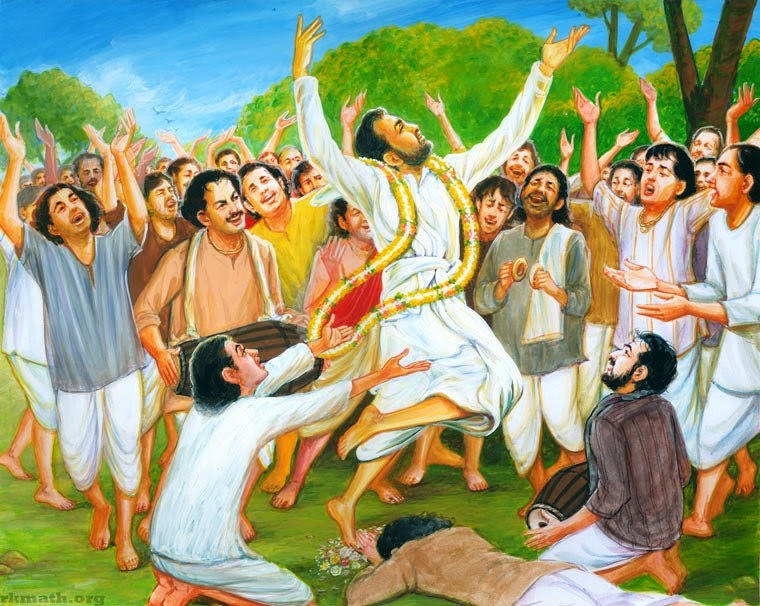

When more disciples and devotees gathered, naturally, it will create a joyful atmosphere. Soon, the room where Sri Ramakrishna stayed became a mart of joy. Day and night, devotional songs were sung to the accompaniment of musical instruments. Ramakrishna spoke to them about God and filled their minds with peace and joy. During the nights, Sri Ramakrishna taught his disciples to meditate on God, and he himself would be in deep communion with God. At times, Ramakrishna visited the houses of the devotees and also other places with them performing Sankirtan and discoursing about God. 

Other youngsters who came to Sri Ramakrishna were Baburam, Shashi, Sharat, Tarak, Subodh, Yogin, Sarada, Hari Prasanna, Hari and Kali. After Sri Ramakrishna attained Mahasamadhi, they renounced the world and became monks.